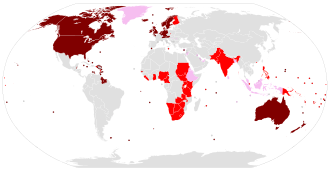
Estimates of native speakers of the Germanic languages vary from 450 million through 500 million and up to more than 520 million. Much of the uncertainty is caused by the rapid spread of the English language and conflicting estimates of its native speakers. Here used is the most probable estimate (currently 515 million) as determined by Statistics section below.
There are various conflicting estimates of L1/native users of English, from 360 million up to 430 million and more. English is a current lingua franca, which is spreading rapidly, often replacing other languages throughout the world, thus making it difficult to provide one definitive number. It is a rare case of a language with many more secondary speakers than natives.
This phenomenon is not restricted to German, but constitutes a common linguistic development affecting all modern day living major languages with a complex set of dialects. As local dialects increasingly cease to be used, they are usually being replaced by a standardized version of the language.
It uses the lowest estimate for English (360 million).
Estimates for English, German and Dutch are less precise than these for the rest of the Germanic languages. These three languages are the most widely spoken ones; the rest are largely concentrated in specific places (excluding Yiddish and Afrikaans), so precise estimates are easier to get.
Estimate includes most High German dialects classified into the German language spectrum, while leaves some out like the Yiddish language. Low German is regarded separately.
All other Germanic languages, including Gutnish, Dalecarlian dialects (among them Elfdalian) and any other minor languages.
Estimates of native speakers of the Germanic languages vary from 450 million through 500 million and up to more than 520 million. Much of the uncertainty is caused by the rapid spread of the English language and conflicting estimates of its native speakers. Here used is the most probable estimate as determined by Statistics section.
Världens 100 största språk 2010 [The world's 100 largest languages in 2010]. Nationalencyklopedin. 2010 [12 February 2014]. (原始内容存档于2012-11-11) (瑞典语).
SIL Ethnologue (2006). 95 million speakers of Standard German; 105 million including Middle and Upper German dialects; 120 million including Low German and Yiddish.
Gechattet wird auf Plattdeusch. Noz.de. [2014-03-14]. (原始内容存档于2018-05-18).
Gechattet wird auf Plattdeusch. Noz.de. [2014-03-14]. (原始内容存档于2018-05-18).
The Other Languages of Europe: Demographic, Sociolinguistic, and Educational Perspectives by Guus Extra, Durk Gorter; Multilingual Matters, 2001 – 454; page 10.
Holmberg, Anders and Christer Platzack (2005). "The Scandinavian languages". In The Comparative Syntax Handbook, eds Guglielmo Cinque and Richard S. Kayne. Oxford and New York: Oxford University Press. Excerpt at Durham University 互联网档案馆的存檔,存档日期3 December 2007..
Världens 100 största språk 2010 [The world's 100 largest languages in 2010]. Nationalencyklopedin. 2010 [12 February 2014]. (原始内容存档于2012-11-11) (瑞典语).
Vasagar, Jeevan. German 'should be a working language of EU', says Merkel's party. 18 June 2013 [2020-08-17]. (原始内容存档于2019-05-12) –通过www.telegraph.co.uk.
Nederlands, wereldtaal. Nederlandse Taalunie. 2010 [2011-04-07]. (原始内容存档于2012-10-21).
Nationalencyklopedin "Världens 100 största språk 2007" The World's 100 Largest Languages in 2007
Census 2011: Census in brief (PDF). Pretoria: Statistics South Africa. 2012. ISBN 9780621413885. (原始内容存档 (PDF)于13 May 2015).
Basbøll, Hans; Jacobsen, Henrik Galberg. Take Danish, for Instance: Linguistic Studies in Honour of Hans Basbøll Presented on the Occasion of His 60th Birthday, 12 July 2003. University Press of Southern Denmark. 2003: 41–57 [2021-05-30]. ISBN 9788778388261. (原始内容存档于2021-11-15) (英语).
Jacobs, Neil G. Yiddish: A Linguistic Introduction. Cambridge University Press. 2005 [2021-05-30]. ISBN 9780521772150. (原始内容存档于2021-11-15) –通过Google Books.
König, Ekkehard; van der Auwera, Johan. The Germanic languages. London: Routledge. 1994.
Wang, Chuan-Chao; Ding, Qi-Liang; Tao, Huan; Li, Hui. Comment on "Phonemic Diversity Supports a Serial Founder Effect Model of Language Expansion from Africa". Science. 2012, 335 (6069): 657. Bibcode:2012Sci...335..657W. ISSN 0036-8075. PMID 22323803. doi:10.1126/science.1207846(英语).